
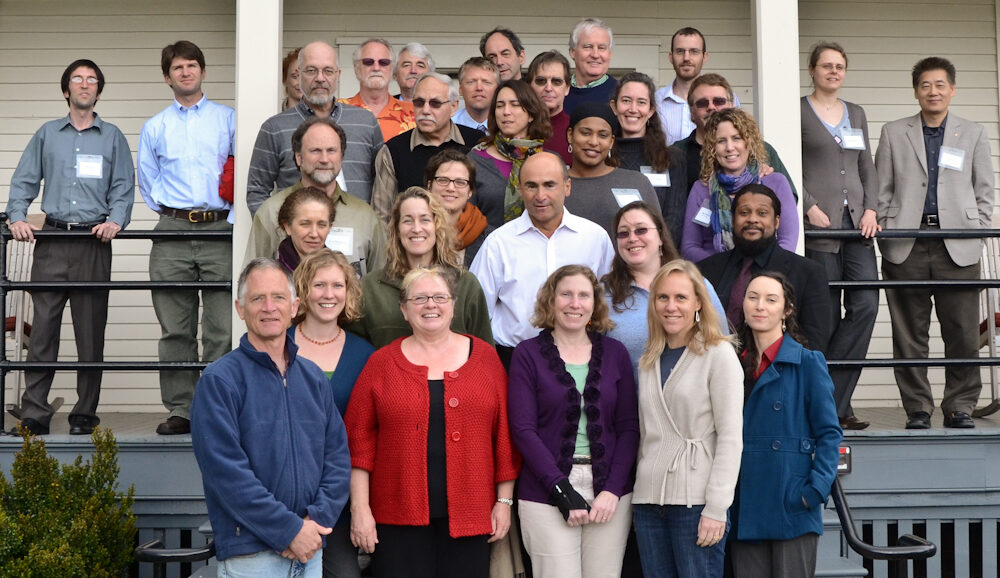
TiPED meeting. Image courtesy of Tom Zoeller.
2013 Reducing Prenatal Exposure to Toxic Environmental Agents committee opinion released by the American College of Obstetricians and Gynecologists (ACOG).
Chemical Exposures During Pregnancy: Dealing With Potential, But Unproven, Risks to Child Health scientific impact paper by The Royal College of Obstetricians & Gynaecologists (RCOG)
Endocrine Disrupting Chemicals in the European Union statement by the Collegium Ramazzini, an international scientific society.
Protection of public health from endocrine disrupters resolution passed by the European Parliament.
The Berlaymont Declaration on Endocrine Disrupters is the result of a meeting by the European Commission.
Key scientific issues relevant to the identification and characterisation of endocrine disrupting substances and the Thresholds for Endocrine Disrupters and Related Uncertainties reports by the Endocrine Disrupters Expert Advisory Group of the European Commission.
Scientific Opinion on the hazard assessment of endocrine disruptors report by EFSA.
Scientists call for changes in chemical regulations to address endocrine disruption
Vandenberg, L. N., Colborn, T., Hayes, T. B., Heindel, J. J., Jacobs, D. R., Jr, Lee, D. H., Myers, J. P., Shioda, T., Soto, A. M., vom Saal, F. S., Welshons, W. V., & Zoeller, R. T. (2013). Regulatory decisions on endocrine disrupting chemicals should be based on the principles of endocrinology. Reproductive toxicology (Elmsford, N.Y.), 38, 1–15.
Industry-funded scientists condemn a hazard-based approach, published simultaneously in multiple journals. These authors were found to have undeclared conflicts of interest.
Dietrich, D. R., Aulock, S. V., Marquardt, H., Blaauboer, B., Dekant, W., Kehrer, J., Hengstler, J., Collier, A., Gori, G. B., Pelkonen, O., Lang, F., Nijkamp, F. P., Stemmer, K., Li, A., Savolainen, K., Hayes, A. W., Gooderham, N., Harvey, A., & Barile, F. A. (2013). Scientifically unfounded precaution drives European Commission’s recommendations on EDC regulation, while defying common sense, well-established science and risk assessment principles. Toxicol: official journal of the International Society on Toxicology, 76, A1–A2.
Followed by rebuttals by EDC scientists:
Bergman, Å., Andersson, A. M., Becher, G., van den Berg, M., Blumberg, B., Bjerregaard, P., Bornehag, C. G., Bornman, R., Brandt, I., Brian, J. V., Casey, S. C., Fowler, P. A., Frouin, H., Giudice, L. C., Iguchi, T., Hass, U., Jobling, S., Juul, A., Kidd, K. A., Kortenkamp, A., … Zoeller, R. T. (2013). Science and policy on endocrine disrupters must not be mixed: a reply to a “common sense” intervention by toxicology journal editors. Environmental health : a global access science source, 12, 69.
Gore, A. C., Balthazart, J., Bikle, D., Carpenter, D. O., Crews, D., Czernichow, P., Diamanti-Kandarakis, E., Dores, R. M., Grattan, D., Hof, P. R., Hollenberg, A. N., Lange, C., Lee, A. V., Levine, J. E., Millar, R. P., Nelson, R. J., Porta, M., Poth, M., Power, D. M., Prins, G. S., … Watson, C. S. (2013). Policy decisions on endocrine disruptors should be based on science across disciplines: a response to Dietrich et al. European journal of endocrinology, 169(6), E1–E4.
Tiered Protocol for Endocrine Disruption (TiPED) effort aims to help in the development of chemicals that aren’t EDCs
Schug, T. T., Abagyan, R., Blumberg, B., Collins, T. J., Crews, D., DeFur, P. L., Dickerson, S. M., Edwards, T. M., Gore, A. C., Guillette, L. J., Hayes, T., Heindel, J. J., Moores, A., Patisaul, H. B., Tal, T. L., Thayer, K. A., Vandenberg, L. N., Warner, J., Watson, C. S., Saal, F. S., … Myers, J. P. (2013). Designing Endocrine Disruption Out of the Next Generation of Chemicals. Green chemistry : an international journal and green chemistry resource : GC, 15(1), 181–198.